
Address format
Ethereum Address or Transaction Hash: How to Tell Them Apart
Separate account addresses from transaction identifiers before copying values into a wallet, explorer or project page.
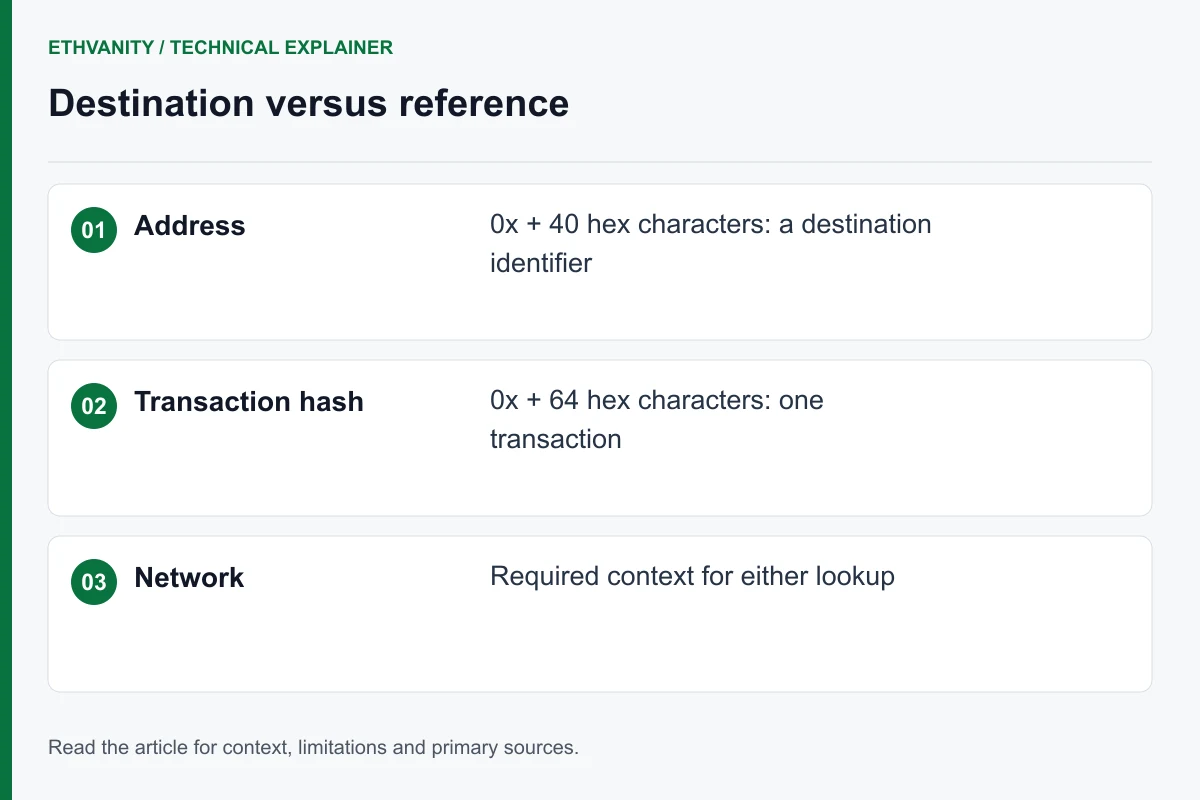
Start with the purpose of the field
Ask what the destination field expects before inspecting the string. A recipient field, an account search and a transaction lookup represent different tasks. Copying a value from a block explorer without keeping its label can remove the most useful clue about what it identifies.
In a team record, keep separate fields for the public address and any transaction reference. Do not use a generic “hash” column for both. Specific labels help reviewers catch a paste error without needing to infer the original workflow.
Length is a check, not proof of correctness
An Ethereum address is a 20-byte value, commonly displayed as 40 hexadecimal characters after 0x. A transaction hash is normally a 32-byte value, shown with 64 hexadecimal characters after that prefix. This difference can expose an obvious mismatch, but a string with the right length still needs context.
Do not shorten a transaction hash to make it fit an address field. That creates a different value rather than correcting the error. Return to the source, identify the account address you intended to use and compare the complete value.
Keep link labels and destinations consistent
A link labelled “View account” should lead to the intended account view, while a transaction reference should open the relevant transaction view. Inspect both the visible label and the destination. A correctly formatted hyperlink can still point at the wrong type of record.
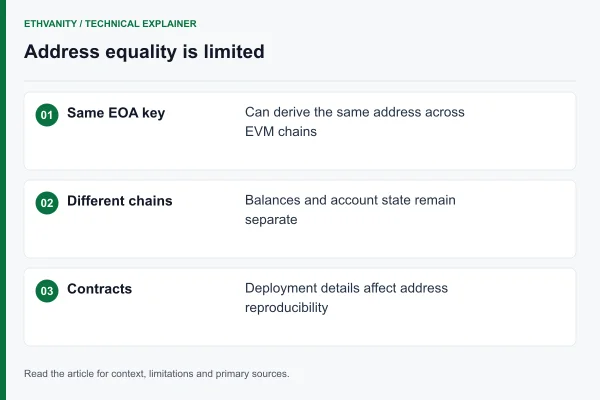
Record the intended network alongside the link. A familiar account identifier does not by itself tell a reader which network state to inspect. The cross-chain address guide explains why this distinction matters.
Review copied values in a plain-text record
When preparing documentation, paste each value into its own labelled field. Compare it with the original source before moving it into a screenshot or presentation. This simple intermediate step reduces confusion caused by truncation or formatting.
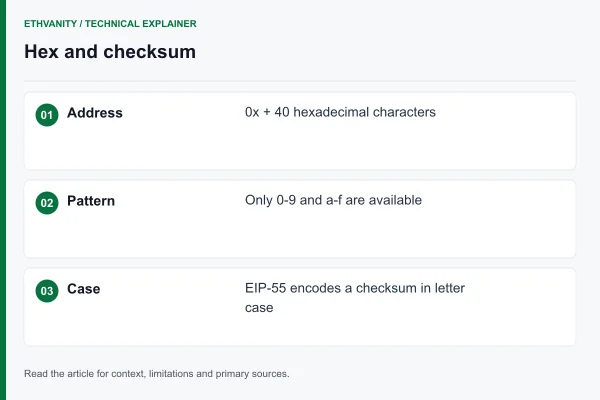
Use the hex and checksum guide for address representation. A checksum is an aid to checking an address representation, not a certificate that you copied the intended recipient or selected the intended network.
Explore the related mechanism
- Ethereum Vanity Address Format: Hex Characters and EIP-55 Checksum — Which characters an Ethereum vanity address can use, how the EIP-55 checksum works, and why case-sensitive patterns need more attempts.
- Same Address on Every EVM Chain: EOAs, CREATE2 and CREATE3 — Why an EOA has the same address on every EVM chain, how contracts match via CREATE2 and CREATE3, and lessons from the 20M OP incident.
- Open the complete workflow guide to place these checks in order.
- Open the address generator when you have chosen a compatible format and pattern.
Sources and editorial method
The technical references below support the concepts discussed in this article. Examples and comparison worksheets are explanatory, not measured service benchmarks.
Read next
Address format8 min read
Ethereum Vanity Address Format: Hex Characters and EIP-55 Checksum
Which characters an Ethereum vanity address can use, how the EIP-55 checksum works, and why case-sensitive patterns need more attempts.
Developer guide7 min read
Same Address on Every EVM Chain: EOAs, CREATE2 and CREATE3
Why an EOA has the same address on every EVM chain, how contracts match via CREATE2 and CREATE3, and lessons from the 20M OP incident.
Security7 min read
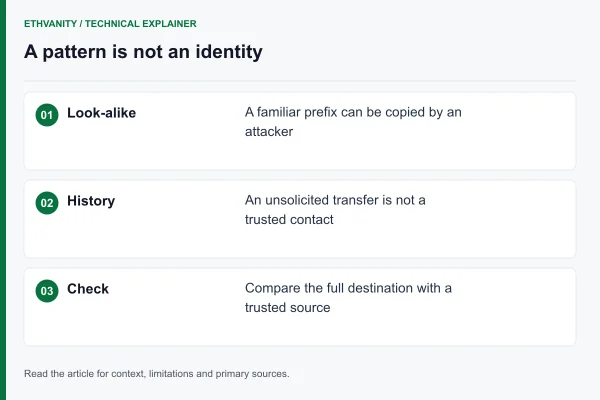
Ethereum Address Poisoning: Look-Alike Address Scams Explained
How address poisoning uses zero-value transfers and look-alike vanity addresses that copy the first and last characters, and how to verify.
Generation5 min read
How to Generate an Ethereum Vanity Address: Prefix or Suffix
Use an ETH address generator with a short hex prefix or suffix. Follow a worked cafe example, review the result and distinguish wallets from ENS and CREATE2.