Developer guide
Leading-Zero Ethereum Addresses: How They Save Gas
Why addresses with leading zero bytes cost less calldata gas (4 vs 16 gas per byte, EIP-2028), with Seaport and Uniswap v4 hook examples.
How Ethereum prices calldata bytes
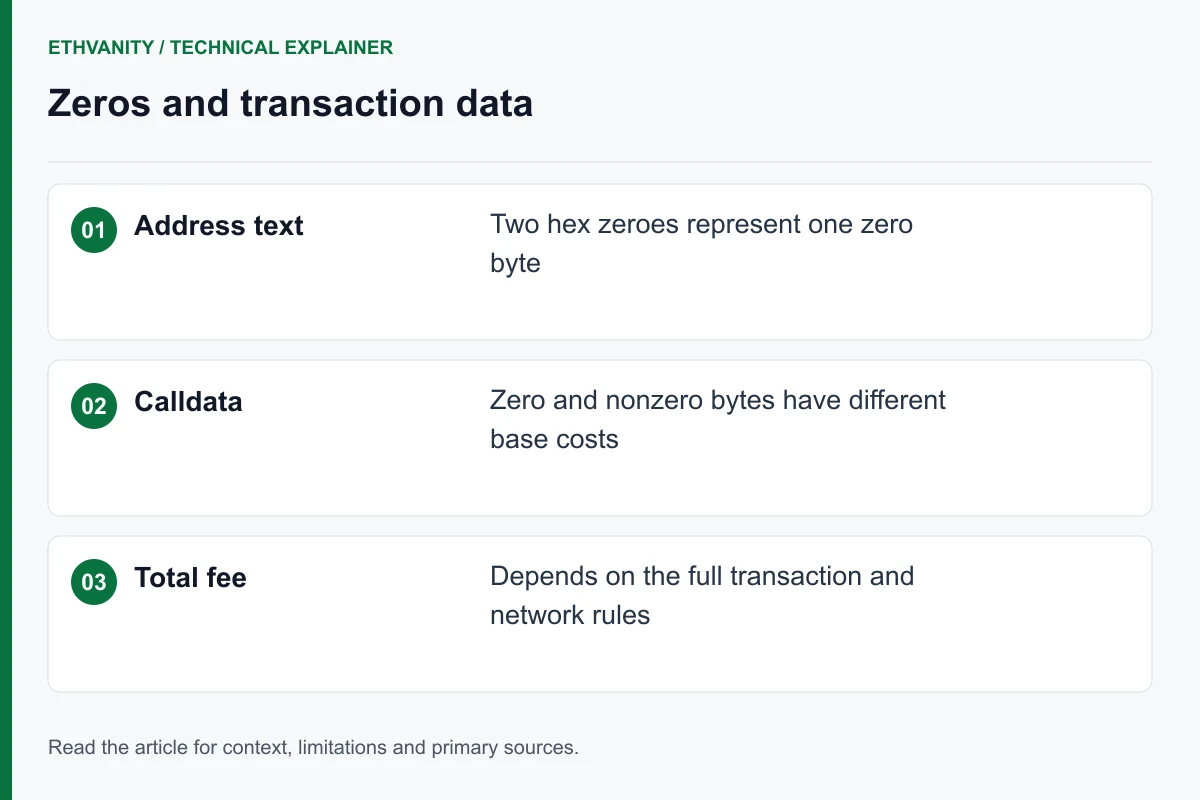
Every transaction pays intrinsic gas for its data field before any code runs. EIP-2028, activated in the Istanbul upgrade in December 2019, cut the price of a non-zero calldata byte from 68 to 16 gas and left zero bytes at 4 gas. A zero byte is therefore four times cheaper than a non-zero byte, a difference of 12 gas per byte.
EIP-7623, included in the Pectra upgrade in 2025, added a floor price for data-heavy transactions. It counts a zero byte as 1 token and a non-zero byte as 4 tokens, and charges at least 10 gas per token when a transaction does little computation. Under that floor a zero byte costs 10 gas and a non-zero byte 40 gas, so the relative advantage of zero bytes is unchanged and the absolute saving grows to 30 gas per byte for floor-priced transactions.
These prices apply to transaction calldata only. Data copied inside the EVM or stored in contract storage follows different rules, so leading zeros matter only where an address travels inside a transaction's input.
| Byte type | Standard cost (EIP-2028) | EIP-7623 floor |
|---|---|---|
| Zero byte (0x00) | 4 gas | 10 gas |
| Non-zero byte | 16 gas | 40 gas |
| Saving per zero byte | 12 gas | 30 gas |
Where a leading-zero address actually saves gas
The ABI encodes an address argument as a 32-byte word: 12 zero bytes of padding followed by the 20 address bytes. If the address itself begins with k zero bytes, the word contains 12 + k zero bytes, and the transaction saves 12k gas every time that word appears in calldata. Seaport 1.5's address has k = 7, saving 84 gas per occurrence compared with a typical address.
The saving applies only where the address is data. The to field of a transaction is not priced per byte, so simply calling a leading-zero contract saves nothing. The benefit appears when other transactions pass the address as an argument, for example a marketplace or conduit address included in signed orders, a router in a swap path, or a token address in approvals. For contracts referenced in very many transactions, a few dozen gas per call adds up across users.
A second, smaller effect is in bytecode. A contract that hard-codes a leading-zero address as a constant can push it with a shorter PUSH instruction, for example PUSH13 instead of PUSH20 for 7 leading zero bytes. Contract code costs 200 gas per byte to deposit at deployment, so 7 fewer bytes save 1,400 deployment gas per occurrence.
Real examples of mined contract addresses
Several widely used contracts were deployed with mined CREATE2 salts. Each address below comes from the project's documentation or repository.
| Contract | Address | Leading zero bytes |
|---|---|---|
| Seaport 1.5 (OpenSea) | 0x00000000000000ADc04C56Bf30aC9d3c0aAF14dC | 7 |
| Seaport 1.1 (OpenSea) | 0x00000000006c3852cbEf3e08E8dF289169EdE581 | 5 |
| Deterministic deployment proxy | 0x4e59b44847b379578588920cA78FbF26c0B4956C | 0 (keyless deployment, not mined) |
| CreateX factory | 0xba5Ed099633D3B313e4D5F7bdc1305d3c28ba5Ed | 0 (vanity ba5Ed prefix and suffix) |
Uniswap v4 hooks: addresses that encode permissions
Uniswap v4 uses address bits for a different purpose. According to the v4 documentation and the Hooks.sol library, a hook contract's permissions are encoded in the least significant 14 bits of its address. Bit 13 is beforeInitialize, bit 7 is beforeSwap, bit 6 is afterSwap, and bits 3 to 0 are the four return-delta permissions. The PoolManager reads these bits to decide which hook functions to call.
Because Hooks.sol validates that every flag matches the permissions the hook declares, all 14 bits are fixed, so a valid address needs on average 2^14 = 16,384 CREATE2 attempts. Uniswap's HookMiner library in v4-periphery performs this search for a given deployer, flag set, creation code and constructor arguments. If the address lacks a flag, the PoolManager never calls that function, and mismatched permissions make deployment fail.
// Uniswap v4: mine a hook address whose low bits encode the flags
uint160 flags = uint160(Hooks.AFTER_ADD_LIQUIDITY_FLAG | Hooks.AFTER_SWAP_FLAG);
bytes memory constructorArgs = abi.encode(POOLMANAGER);
(address hookAddress, bytes32 salt) =
    HookMiner.find(CREATE2_DEPLOYER, flags, type(PointsHook).creationCode, constructorArgs);
// deploy with `salt`, then assert the deployed address == hookAddress
Mining a leading-zero CREATE2 salt
Leading zeros are a prefix pattern, so the difficulty math from the vanity difficulty guide applies: k zero bytes means 2k fixed hex characters, or 256^k expected attempts. Four zero bytes average about 4.29 billion attempts; Seaport 1.5's seven zero bytes correspond to 2^56, about 7.2 x 10^16 attempts on average.
The best-known tool is create2crunch by 0age, a Rust program that takes the factory address, a caller address and the keccak-256 hash of the init code, then writes matching salts and addresses to efficient_addresses.txt. It has an experimental OpenCL GPU mode with thresholds for leading and total zero bytes. Because a CREATE2 salt search involves no private key, it is safe to run on rented hardware; the formula and its pitfalls are in EOA vs CREATE2 vanity.
- Fix the factory and exact init code first; any change to bytecode or constructor arguments invalidates the mined salt.
- Use a caller-restricted salt so the address cannot be taken by someone who sees your deployment transaction.
- Deploy through a factory that exists on every target chain if you want the same address everywhere, as explained in same address on every EVM chain.
Estimating the payoff before you mine
Whether mining is worthwhile depends on how often the address will appear in calldata. Total saving = 12 x k x occurrences gas under standard pricing, where k is the number of leading zero bytes. With 4 zero bytes the saving is 48 gas per occurrence. If the address is passed in 1 million transactions over the contract's life, users save 48 million gas in total; at a hypothetical 10 gwei that equals 0.48 ETH spread across all of them.
Compare that with the search cost. Four zero bytes require about 4.29 billion expected CREATE2 attempts and each extra byte multiplies the work by 256, so going from 4 to 5 zero bytes adds only 12 gas per occurrence but costs 256 times more computation. For most projects, 4 or 5 leading zero bytes is a sensible ceiling, and contracts that are rarely passed as arguments gain nothing worth mining for.
A caution about leading-zero wallets
Leading zeros can also be mined for externally owned accounts, but that requires generating a private key, and the key must come from a secure random source. Wintermute's founder said the firm had used Profanity-type tools to create addresses for gas optimization before its September 2022 loss of about $160 million, which researchers linked to Profanity's weak seed. The Profanity vulnerability explainer covers what went wrong. For contracts, mining a public salt avoids this class of risk entirely.
Explore the related mechanism
- EOA Vanity Address vs CREATE2 Vanity Contract Address — How a vanity wallet (EOA keypair search) differs from a vanity contract address mined with a CREATE2 salt, with the EIP-1014 formulas.
- Same Address on Every EVM Chain: EOAs, CREATE2 and CREATE3 — Why an EOA has the same address on every EVM chain, how contracts match via CREATE2 and CREATE3, and lessons from the 20M OP incident.
- Open the complete workflow guide to place these checks in order.
- Open the address generator when you have chosen a compatible format and pattern.
Frequently asked questions
How much gas does a leading-zero address save?
12 gas per leading zero byte each time the address appears in calldata under standard pricing, or 30 gas per byte for transactions charged the EIP-7623 floor. Calling the contract through the to field saves nothing.
Is it worth mining a leading-zero address for my contract?
It pays off mainly for contracts whose address is passed as an argument in many transactions, such as marketplaces, routers or tokens. For a contract used a few times, the saving is negligible.
Why do Uniswap v4 hook addresses look random but still need mining?
Only the lowest 14 bits matter, and they must exactly match the hook's permissions. That needs about 16,384 attempts on average, which HookMiner does in seconds.
Does a leading-zero address cost less to store?
No. Storage costs depend on whether a slot is zero or non-zero as a whole, not on how many zero bytes a non-zero value contains.
How many leading zero bytes should I mine for?
Each extra zero byte saves 12 more gas per calldata occurrence but needs 256 times more attempts. Estimate how often the address will be passed as an argument and stop when the extra saving no longer justifies the search.
Sources and editorial method
The technical references below support the concepts discussed in this article. Examples and comparison worksheets are explanatory, not measured service benchmarks.
Read next
Developer guide7 min read
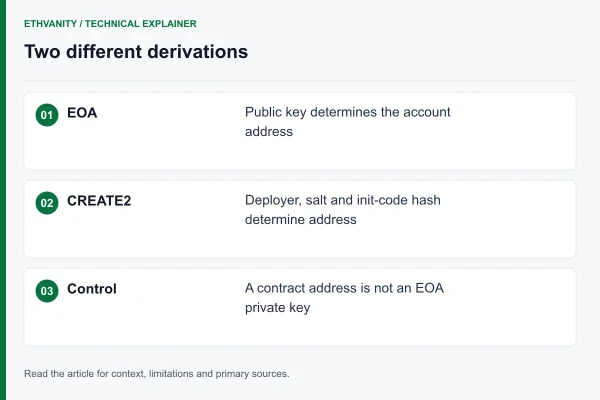
EOA Vanity Address vs CREATE2 Vanity Contract Address
How a vanity wallet (EOA keypair search) differs from a vanity contract address mined with a CREATE2 salt, with the EIP-1014 formulas.
Developer guide7 min read
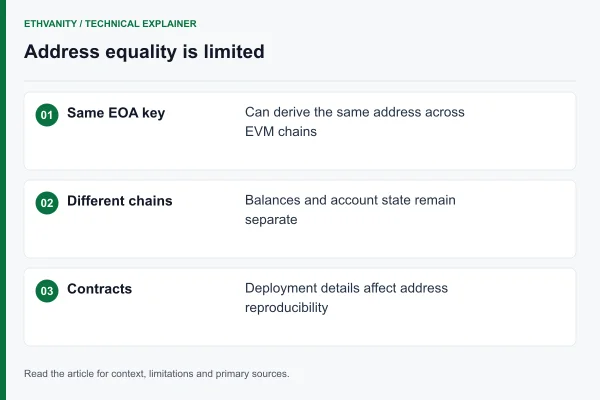
Same Address on Every EVM Chain: EOAs, CREATE2 and CREATE3
Why an EOA has the same address on every EVM chain, how contracts match via CREATE2 and CREATE3, and lessons from the 20M OP incident.
Fundamentals7 min read
How Ethereum Addresses Are Derived from a Private Key
From secp256k1 private key to Keccak-256 hash, last 20 bytes and EIP-55 checksum, with an ethers v6 example and why it is one-way.
Generation5 min read
How to Generate an Ethereum Vanity Address: Prefix or Suffix
Use an ETH address generator with a short hex prefix or suffix. Follow a worked cafe example, review the result and distinguish wallets from ENS and CREATE2.