Comparison
Ethereum Vanity Address vs ENS Name: Which Should You Use?
Compare an Ethereum vanity address with an ENS name: cost, renewal, security, wallet support and when to use both together.
Two tools that solve different problems
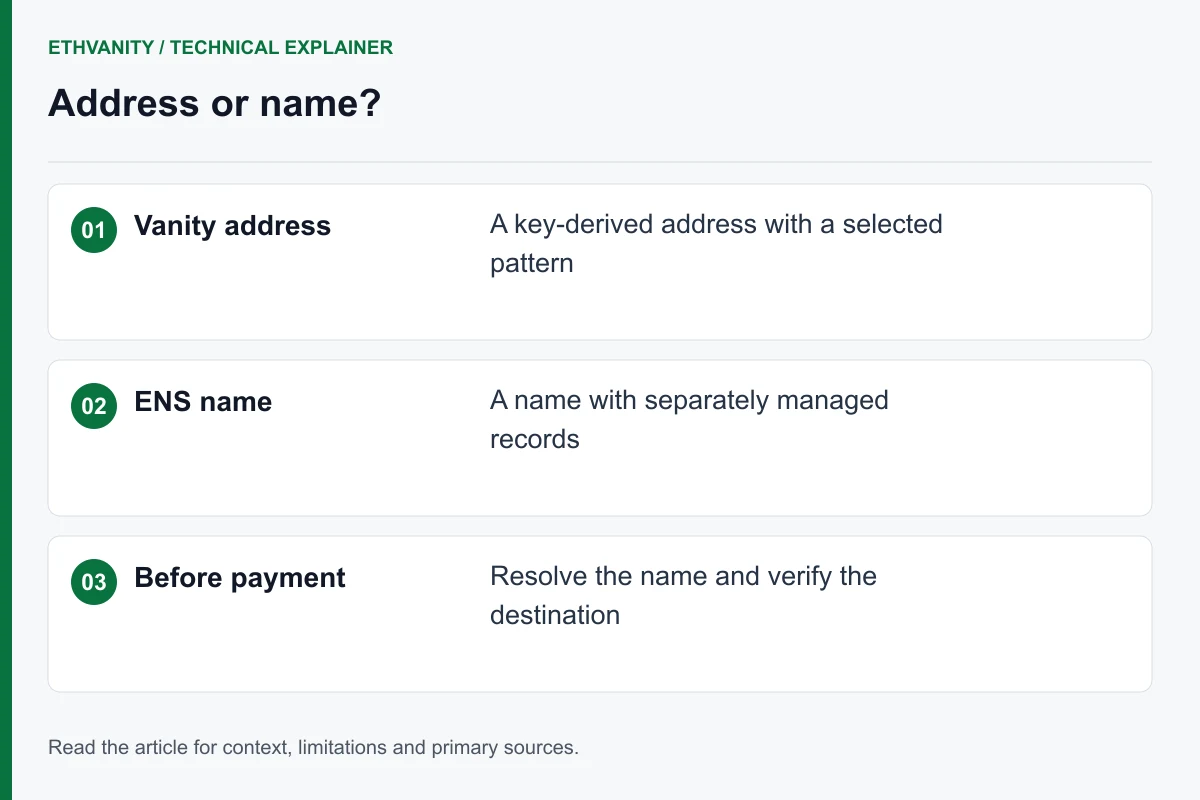
A vanity address is an ordinary externally owned account whose address happens to start or end with chosen hex characters. It is produced by generating many private keys and keeping the one whose derived address matches, a process explained in how Ethereum addresses are derived. Nothing is registered anywhere; the pattern is simply a property of the key you found.
The Ethereum Name Service is a set of smart contracts that maps human-readable names to records. The .eth registrar sells names for a yearly fee, and a resolver contract stores records such as the ETH address, addresses on other chains, a content hash or text records. The underlying address does not change when you register a name; ENS adds a lookup layer on top of it.
Side-by-side comparison
The table summarizes the practical differences. Cost figures for ENS come from the ENS FAQ and support center and are quoted in US dollars but paid in ETH.
| Criterion | Vanity address | ENS .eth name |
|---|---|---|
| What changes | The hex address itself | A name that points to an address |
| Characters | 0-9 and a-f only | Letters, digits, emoji (normalized per ENSIP-15) |
| Recurring cost | None after generation | Yearly fee: $640 for 3 characters, $160 for 4, lower base fee for 5+ |
| Can be lost by inaction | No | Yes, if the registration is not renewed |
| Can be updated | No, a new address means a new key | Yes, records can point to a new address |
| Works in every wallet | Yes, it is a normal address | Only where ENS resolution is supported |
| Main security risk | Weak generator or leaked key | Lapsed name or compromised manager account |
ENS costs, renewal and ownership
According to the ENS FAQ, .eth names cost $640 per year for 3 characters and $160 per year for 4 characters, while 5+ character names use a lower base fee, listed as $5 per year on the FAQ. ENS governance proposal EP 6.43 adjusts the 5+ character price to $8 per year with multi-year discounts under ENSv2, so check the current registrar before budgeting. Names of 1 or 2 characters cannot be registered through the .eth registrar.
Renewal is the important operational difference. A vanity address never expires, but an ENS name that is not renewed eventually returns to the market after its grace period, and someone else can register it and point it at their own address. Anyone who sent funds to the name after that would pay the new owner. Treat ENS renewal like a domain renewal and fund several years in advance.
How ENS resolution works under the hood
ENS does not store names as text. Following ENSIP-1, a name is converted into a 32-byte node with the namehash algorithm: starting from 32 zero bytes, each label from right to left is hashed with keccak256 and combined with the previous node. The ENS registry maps each node to an owner and a resolver contract, and the resolver answers queries such as addr(node), which returns the ETH address.
Because the address lives in a resolver record, the owner can change it at any time with one transaction. That is the main operational advantage over a vanity address: if a key is compromised, you move funds to a new address and update the record, and anyone who sends to the name follows you. With a vanity address, a compromised key means abandoning the address and its recognizability forever.
Resolvers can also hold addresses for other chains. ENSIP-9 defines coin types based on SLIP-44, where ETH is coin type 60, and ENSIP-11 derives coin types for EVM chains as 0x80000000 combined with the chain ID. An EOA usually has the same address on every EVM chain, as covered in same address on every EVM chain, but per-chain records let a name point to different contract wallets on different networks.
Security trade-offs of each approach
A vanity address is only as safe as the randomness used to find it. The 2022 Profanity incident showed that a generator with a 32-bit seed let attackers recompute private keys from public keys, which is described in detail in the Profanity vulnerability explainer. With a sound generator that uses a cryptographically secure random number generator, a vanity key is as strong as any other key.
ENS shifts risk to the name. Homoglyph names that look alike in some fonts are restricted by the ENSIP-15 normalization standard, but similar-looking names can still be registered, so verify the exact name. If your vanity address is used in public, attackers can also mine look-alikes that share its first and last characters, the basis of address poisoning. A memorable pattern does not make that attack harder; full verification does.
Control of an ENS name is split between roles. The registrant owns the name, while the manager or controller can change resolver records, so a phishing attack on the manager account can redirect payments without touching the registration. Keep the owning account on a hardware wallet, and review which address holds each role in the ENS manager app after any transfer or migration.
Using both: primary names and reverse resolution
The two approaches combine well. ENS supports reverse resolution, also called a primary name, which lets an address declare the name it wants wallets and explorers to display. An application can then show alice.eth instead of the hex string, while the forward record still maps alice.eth to the address. Clients should verify that the forward record matches before trusting a reverse record.
A project might therefore use a vanity address such as one starting 0xcafe for recognizability in block explorers and contract interactions, and also register a .eth name for people who need to type it. If you only need something people can remember and say aloud, ENS alone is cheaper and more flexible than an 8-character vanity search, whose 4.3 billion expected attempts are shown in the difficulty guide.
Which one to choose
Use these rules of thumb to pick a starting point.
- Choose ENS if people will type, say or share your identity, if you may need to rotate addresses later, or if you want records for several chains under one name.
- Choose a vanity address if the raw hex must be recognizable, for example in contract addresses, explorer listings or signatures where names are not resolved.
- Choose both for a public project that wants a recognizable address and a typeable name, and set the primary name so explorers display it.
- Skip both if the goal is security: neither a pattern nor a name authenticates a counterparty, and only full address verification does.
Explore the related mechanism
- EOA Vanity Address vs CREATE2 Vanity Contract Address — How a vanity wallet (EOA keypair search) differs from a vanity contract address mined with a CREATE2 salt, with the EIP-1014 formulas.
- Ethereum Address Poisoning: Look-Alike Address Scams Explained — How address poisoning uses zero-value transfers and look-alike vanity addresses that copy the first and last characters, and how to verify.
- Open the complete workflow guide to place these checks in order.
- Open the address generator when you have chosen a compatible format and pattern.
Frequently asked questions
Does registering an ENS name change my Ethereum address?
No. ENS stores a record that points the name to your existing address. The 20-byte address and its private key are unchanged.
Can I get a vanity address that spells my name?
Only if your name can be written with 0-9 and a-f. Most names contain other letters, which is one reason ENS exists. See the hex alphabet guide for workable spellings.
What happens if my ENS name expires?
After the grace period, the name can be registered by someone else, who can point it at a different address. Funds sent to the name afterwards would reach the new owner.
Can an ENS name point to a vanity address?
Yes. The resolver's address record can hold any address, including a vanity one, and setting the primary name lets wallets display the name instead of the hex string.
Do all wallets support ENS names?
Many major wallets and explorers resolve .eth names, but support varies, especially for per-chain records and primary names. When a wallet does not resolve a name, you must enter the full address, so keep it handy and verified.
Sources and editorial method
The technical references below support the concepts discussed in this article. Examples and comparison worksheets are explanatory, not measured service benchmarks.
Read next
Developer guide7 min read
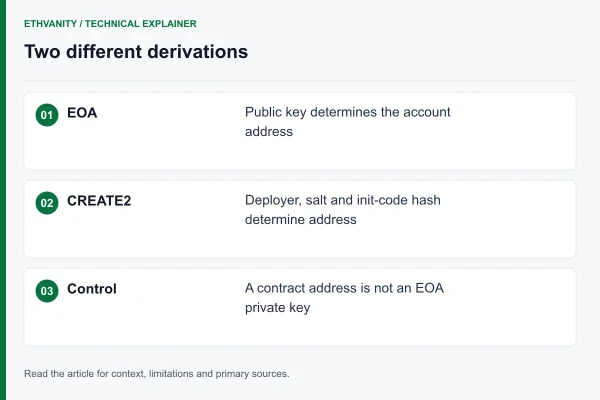
EOA Vanity Address vs CREATE2 Vanity Contract Address
How a vanity wallet (EOA keypair search) differs from a vanity contract address mined with a CREATE2 salt, with the EIP-1014 formulas.
Security7 min read
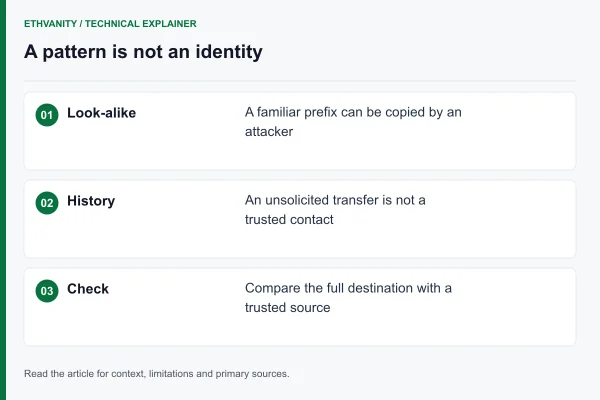
Ethereum Address Poisoning: Look-Alike Address Scams Explained
How address poisoning uses zero-value transfers and look-alike vanity addresses that copy the first and last characters, and how to verify.
Address format8 min read
Ethereum Vanity Address Format: Hex Characters and EIP-55 Checksum
Which characters an Ethereum vanity address can use, how the EIP-55 checksum works, and why case-sensitive patterns need more attempts.
Generation5 min read
How to Generate an Ethereum Vanity Address: Prefix or Suffix
Use an ETH address generator with a short hex prefix or suffix. Follow a worked cafe example, review the result and distinguish wallets from ENS and CREATE2.